The 8,000-Node Challenge: Scalable High-Density Industrial I/O Architecture
11981
419_488_71
71427321893
54121381948
91688
741
8888
519_7148
As facilities integrate thousands of sensors for predictive maintenance, energy monitoring, and process control, automation engineers are facing the 8,000-Node Challenge. Managing eight thousand discrete I/O points or smart devices requires more than just more cables; it requires a fundamental shift in network architecture, data orchestration, and hardware selection to prevent system latency and "data swamps."
The 8,000-Node Environment
An 8,000-node system typically represents a massive logistical operation—think of a gigafactory, a regional distribution center, or a large-scale chemical processing plant. At this scale, the primary enemy is broadcast radiation and network jitter.
If every node sends a heartbeat every 100ms, the sheer volume of traffic can overwhelm standard industrial switches. Architecting for high density isn't just about capacity; it’s about segmentation and determinism.
High-Density Architecture: The Three Pillars
A. Logical Segmentation (VLANs and Subnets)
You cannot place 8,000 nodes on a single "flat" network. The collision domain would be catastrophic. The solution is dividing the plant into logical zones based on the ISA-95 model.
Zone 1 (Process): Time-critical I/O (Safety, Motion).
Zone 2 (Supervisory): Non-critical telemetry (Temperature, Humidity).
Zone 3 (Edge): Data being pushed to the cloud or local MES.
B. Protocol Choice: CIP vs. Profinet vs. MQTT
At 8,000 nodes, the choice of protocol determines your CPU overhead. While EtherNet/IP (CIP) is standard for many Allen-Bradley environments, it can become "chatty." Profinet offers highly deterministic performance for motion, while MQTT (Sparkplug B) is increasingly the preferred choice for high-density sensor networks because it uses a "Report-by-Exception" model, significantly reducing bandwidth.
C. Hardware Concentration (The Gateway Strategy)
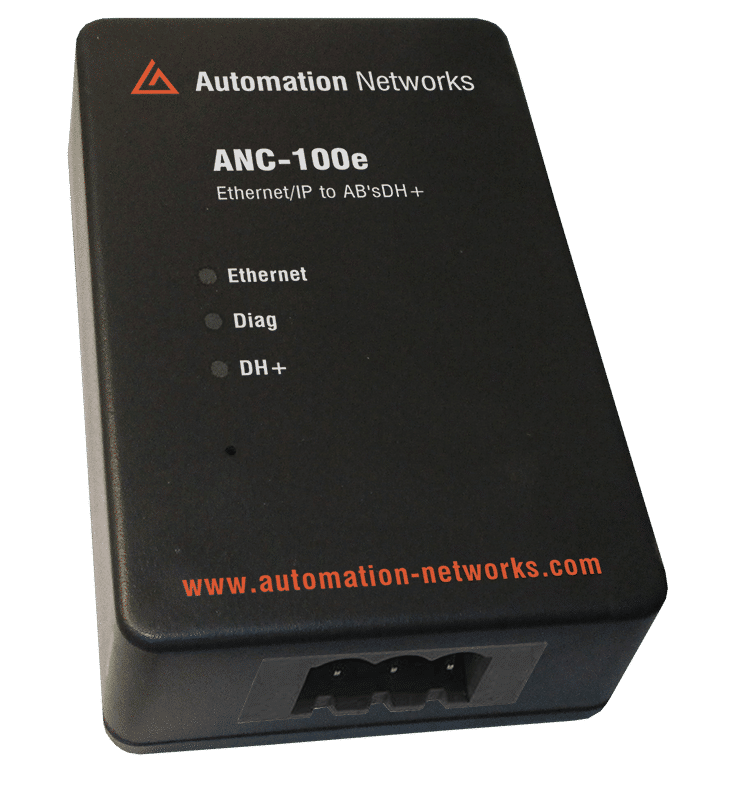
Instead of 8,000 individual home-run cables, high-density architecture relies on Distributed I/O and Protocol Converters. Using high-capacity bridges allows you to aggregate serial or legacy DH+ data into high-speed 1Gbps Ethernet trunks, reducing the physical footprint in the control cabinet.
- Zone 1 (Process): Time-critical I/O (Safety, Motion).
Zone 2 (Supervisory): Non-critical telemetry (Temperature, Humidity).
Zone 3 (Edge): Data being pushed to the cloud or local MES.
C. Hardware Concentration (The Gateway Strategy) Instead of 8,000 individual home-run cables, high-density architecture relies on Distributed I/O and Protocol Converters. Using high-capacity bridges allows you to aggregate serial or legacy DH+ data into high-speed 1Gbps Ethernet trunks, reducing the physical footprint in the control cabinet.
Architectural Layer
Traditional (Small-Scale)
High-Density (8,000+ Nodes)
Impact on Performance
Network Topology
Star / Flat
Redundant Ring / Mesh
Prevents single points of failure.
Polling Method
Cyclic (Always On)
Report-by-Exception (COV)
Reduces network traffic by up to 80%.
CPU Utilization
< 20%
60% - 85% (Requires High-Performance PLCs)
Requires multicore controllers like ControlLogix 80 series.
I/O Concentration
16-pt Modules
32-pt / 64-pt High-Density Modules
Saves 40% cabinet space.
Addressing
IPv4 Static
IPv4 with DHCP Persistence
Simplifies replacement of failed nodes.
The "Producer/Consumer" Model
The "Producer/Consumer" Model
In a high-density environment, you must move away from the "Master/Slave" polling architecture. In a Master/Slave setup, the PLC asks every device for data sequentially. With 8,000 nodes, the last node in the list might only be updated once every few seconds.
By switching to a Producer/Consumer model:
The sensor (Producer) "broadcasts" its data to a specific Multicast address.
Any device that needs that data (Consumer)—be it a PLC, an HMI, or a Historian—simply "listens" for that address.
This allows multiple devices to receive the same data packet simultaneously without increasing the load on the sensor or the network.

When you pack 8,000 I/O points into a control room, you aren't just managing data; you are managing thermal loads. High-density I/O modules generate significant heat. Active Cooling: Forced-air or liquid-cooled cabinets become a requirement. Power Budgeting: 8,000 sensors, even at low wattage, can require hundreds of amps of 24VDC power. Distributed power supplies with built-in redundancy are essential.
The Role of Middleware (KEPServerEX and Beyond)
At this scale, your HMI cannot talk to 8,000 nodes directly. You need a robust Industrial Data Server like KEPServerEX to act as the traffic cop.
Tag Grouping: KEPServerEX can aggregate thousands of Modbus or CIP tags into logical folders.
Load Balancing: You can spread the 8,000 nodes across multiple "Channels" (Network Interface Cards) to prevent any single hardware port from becoming a bottleneck.
Security: Centralizing 8,000 nodes through a single OPC UA endpoint allows you to manage security certificates and user permissions in one place rather than at each individual node.
Predictive Diagnostics. In an 8,000-node system, finding a single broken wire is like finding a needle in a haystack.
Managed Switches: You must use managed switches (Cisco, Stratix) that support SNMP. This allows your SCADA system to "see" which specific port on which switch has a CRC error or a link failure.
Visual Diagnostics: Use "Traffic Light" dashboards that show the health of entire "Zones" rather than individual sensors. An engineer should only "drill down" to the node level once a zone-level alarm is triggered.
The 8,000-Node Challenge is the ultimate test of an automation engineer's architectural skill. Success requires moving beyond "getting it to work" to "optimizing for survival." By utilizing high-density hardware, implementing Producer/Consumer data models, and leveraging powerful middleware like KEPServerEX, you can build a system that is not only vast but also responsive, secure, and ready for the demands of 2026 and beyond.
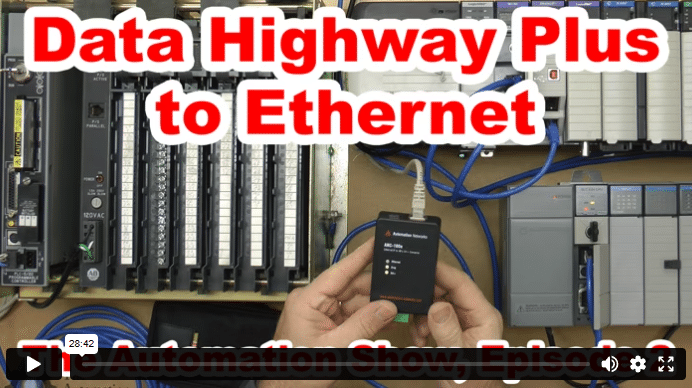
Data Highway Plus to Ethernet (S02)
In today’s episode of The Automation Show, I unbox and setup an ANC-100e Data Highway Plus (DH+) to Ethernet Converter Data Highway Plus to Ethernet bridge from Automation Networks. For more information about the show (and how you could win an ANC-100E) check out the “Show Notes” located below the video. The Automation Show, Episode 2 Show Notes: NOTE: Would you like your … Continue readingData Highway Plus to Ethernet (S02)