Application Interfacing Modbus RTU Devices to OPC UA
11981
419_488_71
71427321893
54121381948
91688
741
8888
519_7148
In the rapidly evolving landscape of Industrial IoT (IIoT) and Industry 4.0, the "language barrier" between the shop floor and the boardroom remains a primary challenge. On one side, we have Modbus RTU, the 1970s-era serial protocol that still powers millions of sensors, meters, and drives. On the other, we have OPC UA, the modern, secure, and platform-independent standard for high-level data exchange. Interfacing these two isn't just a technical task—it's the foundational application that turns raw electrical signals into actionable business intelligence.
Why an Interface is Necessary
To understand the application of interfacing these protocols, one must first recognize their fundamental differences.
Modbus RTU is a "bare-metal" protocol. It communicates over RS-485 or RS-232 serial lines using a master-slave architecture. It is efficient and simple but lacks security, metadata, and scalability. It sees the world as a series of 16-bit registers (e.g., $40001$). It doesn't know if $40001$ is a temperature, a pressure, or a motor speed; it only knows it is a number.
OPC UA (Open Platform Communications Unified Architecture) is a service-oriented architecture. It is "semantic," meaning the data carries its own context. An OPC UA server doesn't just send the value 72.5; it sends an object called Ambient_Temperature with units in Fahrenheit, a timestamp, and a quality indicator.
Key Applications for Modbus to OPC UA Interfacing
The application of this interface serves three primary functions in a modern industrial environment:
A. Energy Management and Power Monitoring
Most industrial power meters (like those from Schneider, Eaton, or ABB) use Modbus RTU. By interfacing these meters to an OPC UA server, facilities managers can pull real-time energy consumption data into high-level dashboards (like Ignition or AVEVA). This allows for peak-demand tracking and automated energy reporting without manual meter readings.
B. Legacy Asset Integration (VFDs and Sensors)
Many older Variable Frequency Drives (VFDs) and specialized environmental sensors (humidity, $CO_2$) only offer RS-485 Modbus ports. Interfacing these to OPC UA allows them to be treated as modern Ethernet devices. This "wraps" the legacy hardware in a secure, manageable Ethernet envelope.
C. Edge-to-Cloud Connectivitys
Modern cloud platforms like Azure IoT Hub or AWS IoT SiteWise do not speak Modbus RTU. They require structured data, often via MQTT or OPC UA. The interface acts as an "Edge Gateway," translating the serial pulses of a PLC or sensor into the secure, certificate-based language required by the cloud.
Most industrial power meters (like those from Schneider, Eaton, or ABB) use Modbus RTU. By interfacing these meters to an OPC UA server, facilities managers can pull real-time energy consumption data into high-level dashboards (like Ignition or AVEVA). This allows for peak-demand tracking and automated energy reporting without manual meter readings.
B. Legacy Asset Integration (VFDs and Sensors)
Many older Variable Frequency Drives (VFDs) and specialized environmental sensors (humidity, $CO_2$) only offer RS-485 Modbus ports. Interfacing these to OPC UA allows them to be treated as modern Ethernet devices. This "wraps" the legacy hardware in a secure, manageable Ethernet envelope.
C. Edge-to-Cloud Connectivitys
Modern cloud platforms like Azure IoT Hub or AWS IoT SiteWise do not speak Modbus RTU. They require structured data, often via MQTT or OPC UA. The interface acts as an "Edge Gateway," translating the serial pulses of a PLC or sensor into the secure, certificate-based language required by the cloud.
The Translation Table
Modbus RTU Element (Source)
OPC UA Element (Target)
Value Added
Slave ID / Address
Node ID / Name
Human-readable identification (e.g., "Boiler_1").
Register 40001 (Raw)
Variable Value (Scaled)
Converts raw integers to floating-point engineering units.
None
Timestamp
Adds "Date Certainty" to when the data was read.
None
Status/Quality Code
Indicates if the serial wire is broken or noisy.
Clear Text (Unsecure)
Encrypted Payload
Protects the data from being sniffed on the network.
Hardware vs. Software Interfacing
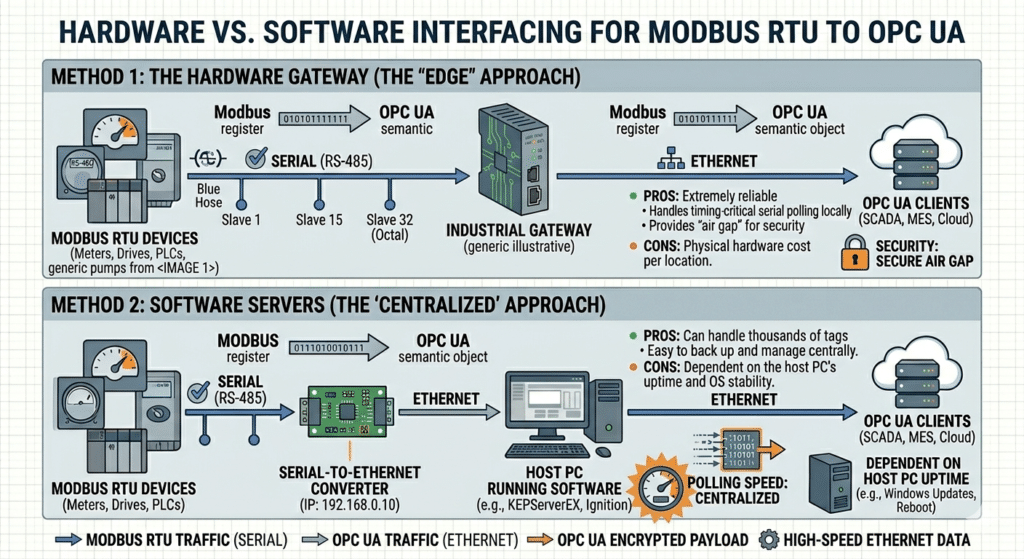
The "application" of this interface can be achieved through two primary methods:
Method 1: The Hardware Gateway (The "Edge" Approach)
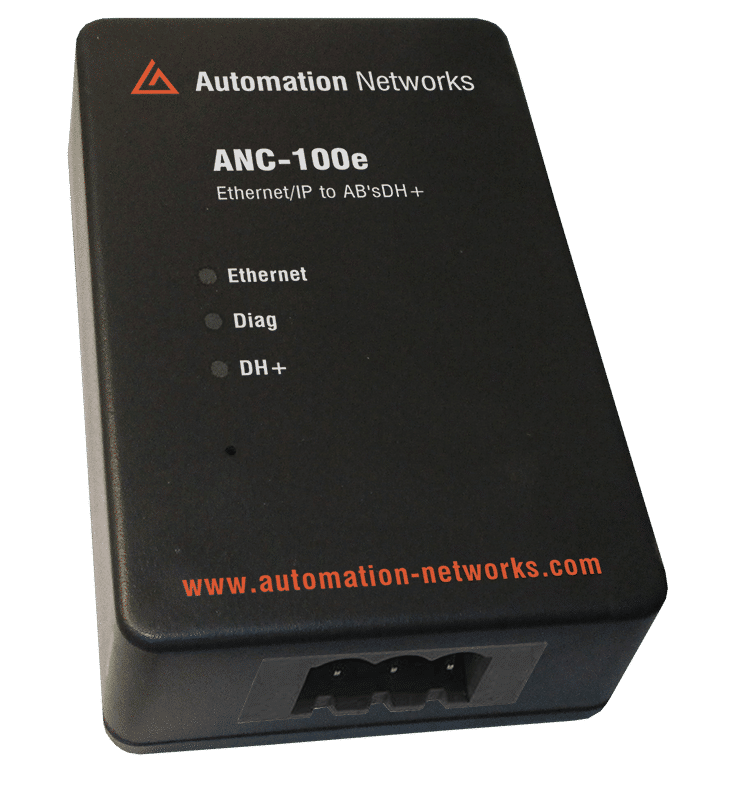
Devices like the ANC-100e or generic industrial gateways act as a physical bridge.
Pros: Extremely reliable; handles the timing-critical serial polling locally; provides an "air gap" for security.
Cons: Physical hardware cost per location.
Method 2: Software Servers (The "Centralized" Approach)
Software like KEPServerEX or Ignition's Modbus Driver runs on a PC with a serial-to-Ethernet converter.
Pros: Can handle thousands of tags; easy to back up and manage centrally.
Cons: Dependent on the host PC's uptime and OS stability.
Performance Optimization
The most critical part of this application is managing the "speed mismatch." Ethernet is fast ($100Mbps+$), but Modbus RTU is slow ($9.6kbps$ to $115kbps$).
- Poll Groups: Instead of asking for every tag at once, group your data. Read "Process Critical" data every 500ms and "Diagnostic" data (like serial numbers or runtime hours) every 5 seconds.
- Contiguous Reads: Modbus is much faster when reading a block of 100 registers than when making 100 separate requests for 1 register. A good interface application will "pack" these requests automatically.
- Deadbanding: Don't send data to the OPC UA client unless it changes. If a tank level hasn't moved, the interface should remain silent, saving precious network bandwidth.
Modbus RTU is inherently insecure—anyone with a wire stripper and a laptop can intercept or spoof data.
By interfacing to OPC UA, you are implementing Security by Proxy. The OPC UA server requires:
X.509 Certificates: Only authorized HMIs can talk to the data.
Encryption (AES-256): The data is garbled for anyone trying to "sniff" the Ethernet line.
User Authentication: You can track exactly who changed a setpoint or stopped a motor.
The application of interfacing Modbus RTU to OPC UA is the bridge that spans forty years of industrial evolution. It allows engineers to keep their perfectly functional legacy hardware while gaining the analytical power of modern software. Whether you are monitoring a single pump or an entire global fleet of VFDs, this interface is the key to moving from "knowing the numbers" to "understanding the process."
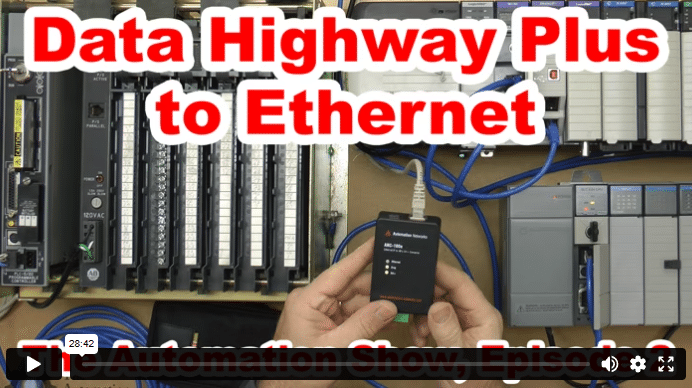
Data Highway Plus to Ethernet (S02)
In today’s episode of The Automation Show, I unbox and setup an ANC-100e Data Highway Plus (DH+) to Ethernet Converter Data Highway Plus to Ethernet bridge from Automation Networks. For more information about the show (and how you could win an ANC-100E) check out the “Show Notes” located below the video. The Automation Show, Episode 2 Show Notes: NOTE: Would you like your … Continue readingData Highway Plus to Ethernet (S02)