Modern HMI Access to Legacy Allen-Bradley PLC-5 & SLC 5/04 via DH+ and KEPServerEX
11981
419_488_71
71427321893
54121381948
91688
741
8888
519_7148
As industrial facilities transition toward Digital Transformation and Industry 4.0, a recurring obstacle is the "Legacy Gap." Thousands of perfectly functional Allen-Bradley PLC-5 and SLC 5/04 controllers are still orchestrating critical processes, yet they lack the native Ethernet connectivity required by modern SCADA and HMI platforms. This guide explores how to bridge the legendary Data Highway Plus (DH+) "Blue Hose" to the modern enterprise using the ANC-100e gateway and KEPServerEX, providing a high-speed, secure, and scalable data bridge.
The Persistence of the Legacy Controller
In many industrial sectors, the PLC-5 and SLC 5/04 are the "iron horses" of automation. These controllers were built for longevity, often outlasting the human operators who first programmed them. However, their native communication protocol—DH+—is a proprietary, token-passing serial network that operates at speeds (57.6k to 230.4k) far below modern 1Gbps Ethernet standards.
The challenge for modern maintenance managers is clear: How do you extract real-time data for an Ignition, FactoryTalk View, or Wonderware HMI without performing a risky and expensive "rip-and-replace" of the entire control system?
DH+ to OPC UA
To bring legacy data into a modern HMI, we implement a three-layer "Bridge Architecture" that translates hardware-level signals into software-level tags.
Layer 1: The Physical DH+ Bridge (ANC-100e)
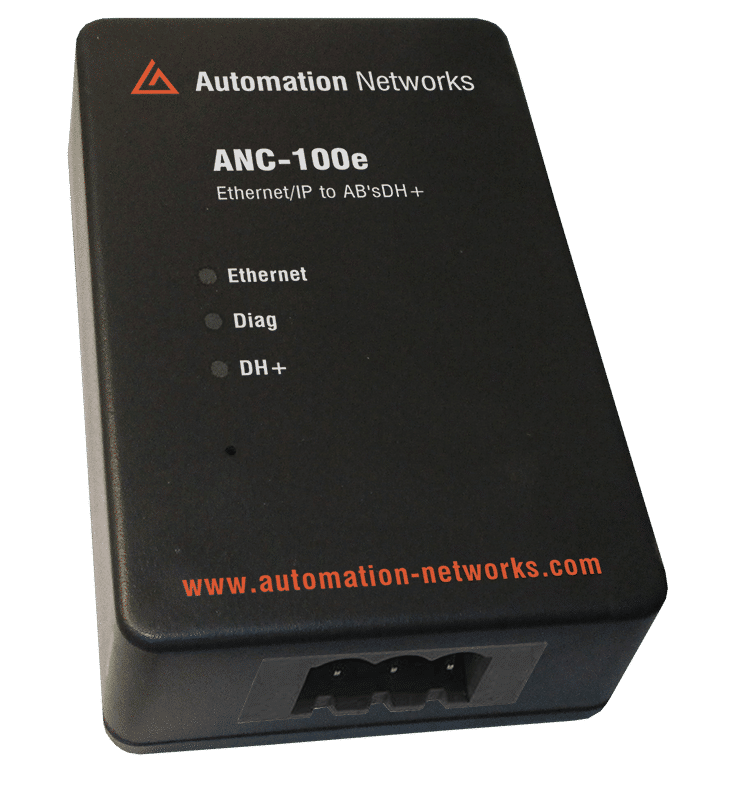
The ANC-100e acts as the physical translator. It connects directly to the DH+ Blue Hose and presents itself on the Ethernet network as a high-performance gateway. Unlike older serial-to-USB converters, the ANC-100e is an industrial-grade device that supports the Auto-Detect feature to identify baud rates and node addresses instantly, preventing network collisions.
Layer 2: The Middleware Driver (KEPServerEX)
Once the data is on the Ethernet backbone, KEPServerEX acts as the communications "traffic cop". Using the Allen-Bradley ControlLogix Ethernet Driver, KEPServerEX "routes" its requests through the ANC-100e to the specific Octal node address of the legacy PLC.
Layer 3: The Visualization Layer (Modern HMI)
The HMI connects to KEPServerEX via OPC UA. At this stage, the HMI is completely insulated from the complexities of DH+. It simply requests a tag like Boiler_01_Temp, and the middleware handles the multi-protocol translation in milliseconds.
Traditional vs. Modern Bridge
Feature
Legacy RSLinx/Serial Method
ANC-100e + KEPServerEX
Physical Interface
1784-U2DHP (USB Dongle)
ANC-100e (DIN-Rail Gateway)
Driver Type
Proprietary Serial Driver
Standard Ethernet/IP (CIP)
Simultaneous Users
Often limited to 1 connection
Multiple HMI/MES connections
Setup Complexity
High (Manual Baud/Node settings)
Low (Auto-Detect Utility)
Reliability
Prone to driver "crashes"
24/7 Industrial Uptime
Step-by-Step Implementation Strategy
Phase 1: Hardware Integration
The ANC-100e is installed in the control cabinet and wired into the existing DH+ trunk. By utilizing the Auto-Detect button in the ANC-100e web interface, the system automatically identifies the current network speed and active nodes, ensuring the gateway doesn't conflict with existing PLCs.
Phase 2: KEPServerEX Routing
In KEPServerEX, you create a new channel using the Allen-Bradley ControlLogix Ethernet driver. The "Device" is configured with a specific routing path:
- IP Address: The IP of the ANC-100e.
- Routing Path: Directs the packet from the Ethernet port, through the gateway, to the DH+ Octal Node (e.g., Node 15).
Phase 3: Tag Optimization
Because DH+ is slower than Ethernet, tag optimization is critical. KEPServerEX allows you to group legacy data into "Scan Classes." Critical alarms can be polled every 500ms, while non-critical data (like hour meters) can be polled every 10 seconds to keep the DH+ network from becoming congested.
Security: Shielding the Blue Hose
Legacy DH+ has zero built-in security. By using the ANC-100e and KEPServerEX bridge, you essentially "wrap" the legacy network in a modern security blanket:
OPC UA Encryption: Data traveling from KEPServerEX to the HMI is encrypted via X.509 certificates.
VLAN Isolation: The legacy PLCs can be kept on a private, non-routable network, with the ANC-100e acting as the only controlled entry point.
Read-Only Access: You can configure KEPServerEX to provide "Read-Only" access to legacy registers, preventing unauthorized changes to the PLC logic from the HMI layer.

Real-World Benefits
Connecting your PLC-5 and SLC 5/04 systems to a modern HMI via KEPServerEX unlocks more than just pretty screens:
Historical Trending: Modern HMIs can now log legacy data into SQL databases for long-term analysis.
Mobile Access: Operators can view legacy machine status on tablets or smartphones via the modern HMI web-server.
IIoT Integration: Data can be forwarded from KEPServerEX to MQTT brokers or cloud platforms (AWS/Azure) for predictive maintenance.
The goal of industrial modernization shouldn't be to replace hardware that still works; it should be to make that hardware's data useful for the modern enterprise. By combining the physical bridging power of the ANC-100e with the software intelligence of KEPServerEX, facilities can enjoy the benefits of a Modern HMI while respecting the reliability of their Legacy Allen-Bradley infrastructure.
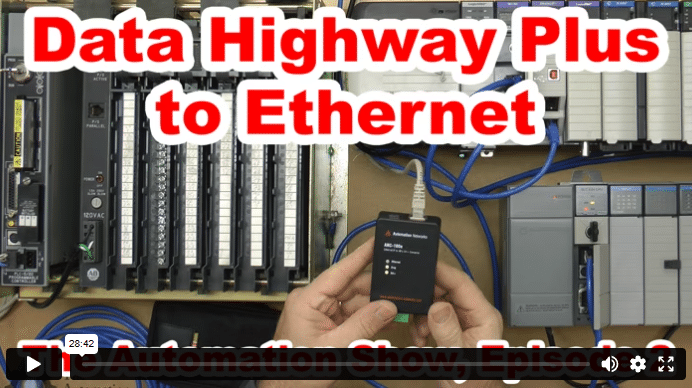
Data Highway Plus to Ethernet (S02)
In today’s episode of The Automation Show, I unbox and setup an ANC-100e Data Highway Plus (DH+) to Ethernet Converter Data Highway Plus to Ethernet bridge from Automation Networks. For more information about the show (and how you could win an ANC-100E) check out the “Show Notes” located below the video. The Automation Show, Episode 2 Show Notes: NOTE: Would you like your … Continue readingData Highway Plus to Ethernet (S02)