
Zero-Trust Integration view for Legacy OT Networks 2026
Exploring how to implement Zero-Trust Architecture (ZTA) across legacy protocols like Modbus and BACnet without replacing expensive hardware.
Connectivity vs. Risk
In the current panorama, the push for Artificial Intelligence in manufacturing requires real-time data from every corner of the plant floor. However, legacy Operational Technology (OT) was never designed for the open web.
The Protocol Bridge is no longer just about converting Modbus to MQTT; it is about creating a secure, verified tunnel for every bit of data. That is why we explore a Zero-Trust Integration view for Legacy OT Networks 2026
What is Zero-Trust OT Integration?
Zero-Trust OT is a security framework requiring strict identity verification for every person and device trying to access resources on a private network, regardless of whether they are sitting inside or outside the network perimeter.
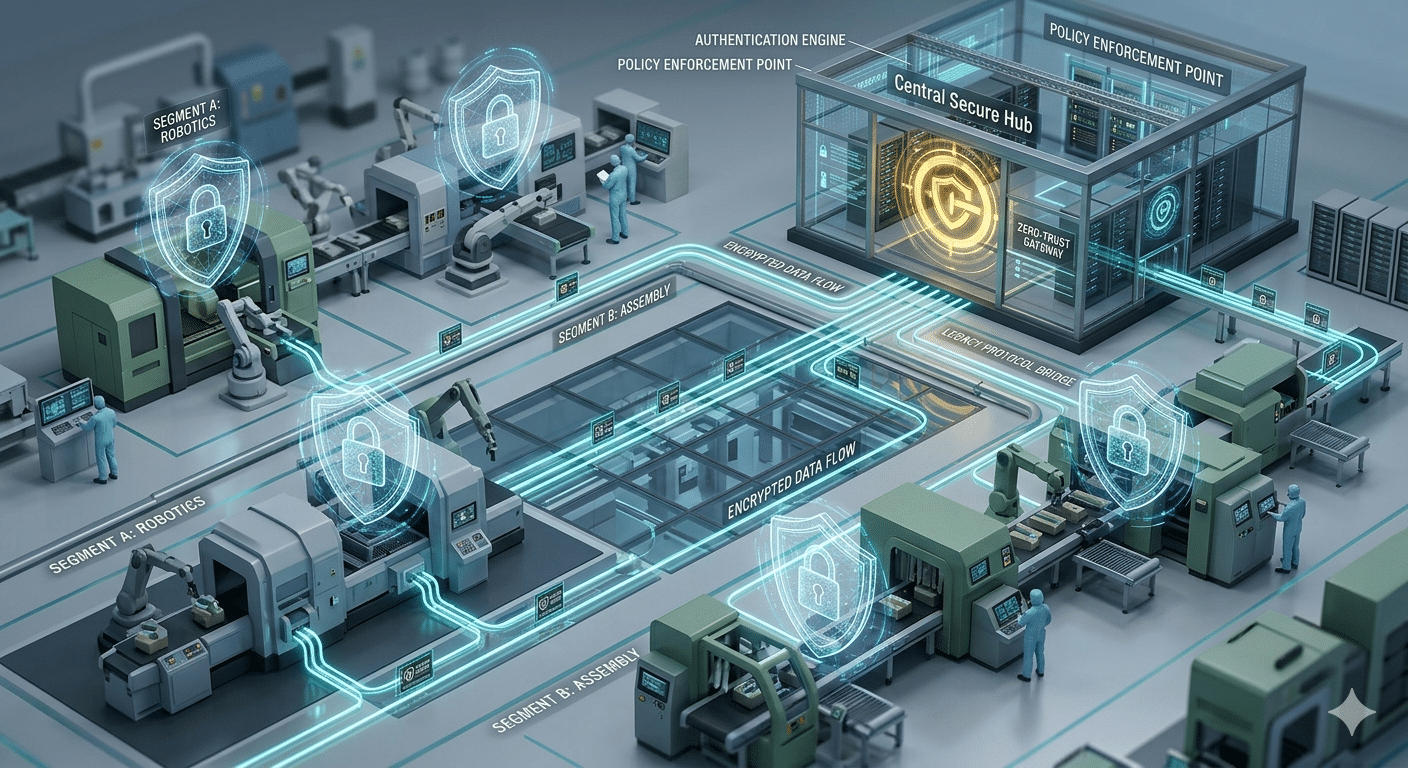
Legacy to Encrypted
Most legacy PLCs communicate in "plaintext." If a hacker gains access to the switch, they can read your entire process. The 2026 standard for bridging these involves Software-Defined Perimeters (SDP).
Protocol Security Comparison Matrix
Legacy
Protocol
Native Security
2026 Best Practice
Recommended Bridge
Modbus TCP
None
TLS 1.3 Wrapper
Edge Gateway w/ TPM
EtherNet/IP
Limited
CIP Security™
Deep Packet Inspection (DPI)
BACnet
Low
BACnet/SC (Secure Connect)
Virtual Private Pipes
OPC DA
DCOM (Vulnerable)
Migrate to OPC UA
Micro-segmentation
Access Model
To protect your automation network, you must move away from shared passwords and open ports. In 2026, we utilize Micro-segmentation.
Identity-Based Polling: Instead of a SCADA system having "always-on" access to a PLC, use an intermediary broker that requires a digital certificate for each data request.
Hardware Roots of Trust: Ensure your protocol converters use hardware-based encryption (like TPM 2.0 chips) to store security keys.
Just-In-Time (JIT) Access: Technical support should only have access to the PLC logic during a scheduled maintenance window, automatically revoked by the network once the window closes.
Agentic AI in Network Monitoring and its role
Static firewalls are no longer enough. High-quality automation networks in 2026 now employ Autonomous Monitoring Agents. These agents learn the "heartbeat" of your traffic.
Anomaly Detection: If a Modbus register that usually updates every 100ms suddenly starts updating every 10ms, the agent flags a potential buffer overflow attack.
Automated Quarantining: If a device is compromised, the network fabric can logically "unplug" that specific IP without shutting down the entire assembly line.
Prepare your Network
Before connecting your factory floor to a cloud-based analytics engine, verify these five points:
- All legacy traffic is encapsulated in an encrypted tunnel (e.g., WireGuard or TLS).
- Multi-Factor Authentication (MFA) is required for all HMI access.
- Network "East-West" traffic is restricted (PLCs cannot talk to other PLCs unless strictly necessary).
- Firmware updates are signed and verified via a centralized management console.
You have a "Read-Only" data diode for cloud-based monitoring to prevent reverse-command injection.
The new connectivity is security
In 2026, the most efficient automation networks aren't just the fastest—they are the most resilient. By treating every protocol bridge as a security checkpoint, you ensure that your transition to smart manufacturing doesn't become a liability.
The ANC-120e is an economical and high performance USB-to-Allen-Bradley Data Highway Plus converter interfacing major HMI, SCADA, PLC Programming packages to Devices on DH+. Its features significantly outperform the Allen-Bradley 1784-U2DHP PLC Programming Cable operating at 12 Mg USB speed with the Controllogix Ethernet/IP Driver.
The ANC-120e works with all SCADA, MMI, PLC programming packages installed on your PC with USB direct access to the Allen-Bradley DH+ network and stations such as PLC-5 and SLC 5/04s. These packages include RSLINX/LOGIX Classic & Enterprise with RSLOGIX 5/500, Wonderware DAServer & TCP/IO Server, Citect, and Kepware using Controllogix Ethernet/IP Drivers.
$995 USD
January 1,2026
