The ANC-124 is Programming Cable for A-B PLCs
Field service technicians, system integrators, and plant engineers frequently encounter situations where a single automation platform uses entirely different physical serial interfaces across various generations.
One of the most common issues occurs when moving between the Allen-Bradley SLC 500 series and the MicroLogix controller family. While both platforms natively support RS-232 serial communication utilizing the DF1 protocol, their physical ports are entirely different. The SLC 500 family utilizes a standard 9-pin D-sub (DB9) connector, whereas the MicroLogix family employs a compact, proprietary round 8-pin Mini-DIN connection.
The Automation Networks ANC-124 is a hardware converter designed to address this physical mismatch. Formally classified as the ANC-124 Allen-Bradley Adapter 1761-CBL-PM02 for 1747-CP3 programming cable, this compact adapter converts a standard SLC 500 serial cable into a MicroLogix-compatible programming interface. Rather than requiring technicians to carry distinct, bulky programming cables for every individual PLC platform, the ANC-124 adapts existing DB9-based programming lines directly into an 8-pin Mini-DIN port
What is the ANC-124 Adapter
The ANC-124 is a cross-platform serial adaptation tool. It is not a standalone cable that connects a PC directly to a PLC; instead, it is an intermediary adapter. It acts as a mechanical and electrical bridge between two highly common, legacy Allen-Bradley programming cable standards:
- The Input Side (Receiving End): A female DB9 connection port structurally pinned out to receive the male end of an Allen-Bradley 1747-CP3 cable.
- The Output Side (Device End): A round, male 8-pin Mini-DIN connector designed to emulate the pin layout of an Allen-Bradley 1761-CBL-PM02 cable, allowing it to insert directly into the Channel 0 serial port of a MicroLogix controller.
By plugging the ANC-124 onto the end of an active 1747-CP3 serial cable (or a modern equivalent like the USB-based 1747-CP3 variant), you instantly alter its physical termination. This shifts the application scope of the host cable from an SLC 500 or ControlLogix processor over to the MicroLogix platform without modifying software drivers, changing COM port assignments, or altering RSLinx settings.
What Does the ANC-124 Adapter Do
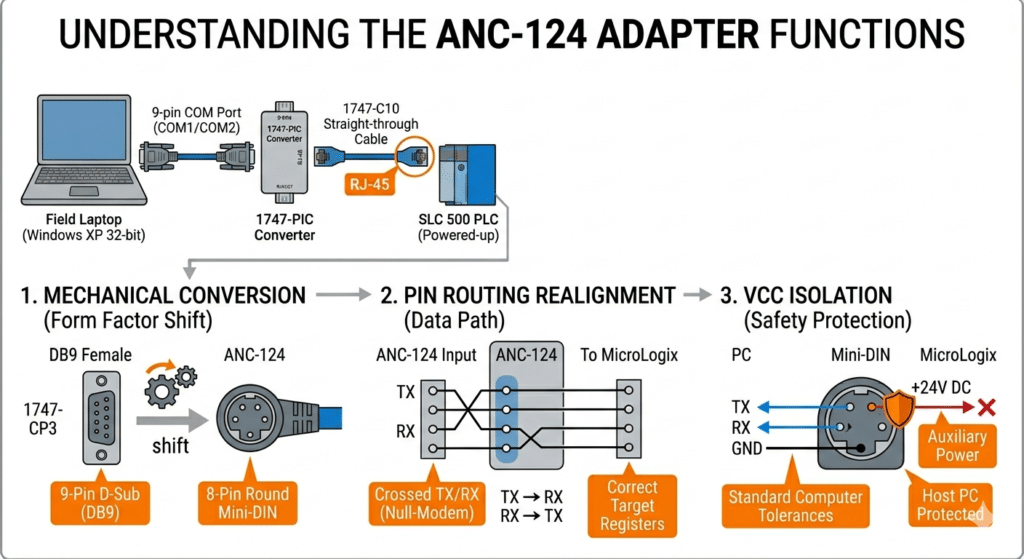
The principal function of the ANC-124 is pin mapping and mechanical conversion. Because both the SLC 500 (Channel 0) and the MicroLogix (Channel 0) use RS-232 signaling logic based on the Rockwell DF1 protocol, they are completely compatible from a software perspective. They understand the exact same data packets, baud rates, and parity settings. The barrier to communication is strictly physical.
The adapter performs the following critical tasks:
1. Mechanical Form Factor Adaptation: Standard laptops, desktop workstations, and conventional USB-to-Serial converter units terminate in standard D-subminiature 9-pin (DB9) male configurations. This mates natively with the female DB9 port found on the front of an SLC 5/03, 5/04, or 5/05 processor using a standard 1747-CP3 null-modem cable.
However, MicroLogix controllers use an 8-pin Mini-DIN socket to save space on their compact, din-rail-mounted footprints. The ANC-124 takes the incoming 9-pin serial rows and physically translates them into the precise concentric layout of the 8-pin Mini-DIN plug, permitting an immediate mechanical match.
2. Internal Null-Modem and Pin Routing Realignment. An RS-232 connection requires proper routing of the Transmit (TX), Receive (RX), and Signal Ground (GND) lines. A standard 1747-CP3 serial cable is inherently a null-modem cable, meaning its internal wiring crosses the TX and RX lines (Pin 2 on one end connects to Pin 3 on the other, and vice versa) so that the computer's transmission line directly links to the PLC's receiving register.
The MicroLogix 8-pin Mini-DIN port maps these same functions to completely different contact locations. The internal circuitry of the ANC-124 ensures that the crossed TX/RX signals emerging from the 1747-CP3 null-modem line are routed exactly to the correct pins within the 8-pin Mini-DIN head. Without this specific realignment, signals would dead-end into unmapped or incorrect pins on the microprocessor board, preventing communication initialization.
3. VCC Isolation and Protection. As observed on legacy systems, industrial controller programming ports often carry auxiliary DC power to drive peripheral accessories like handheld programmers, network interface converters, or isolation modules. The MicroLogix 8-pin Mini-DIN interface supplies +24V DC power on specific pins.
A standard, uninsulated homebrew serial adapter could inadvertently bridge this +24V power line straight back into the TX/RX communication lines of a standard PC serial port or an unshielded USB-to-Serial converter, instantly destroying the computer's motherboard or serial interface. The ANC-124 provides the mechanical isolation necessary to shield your computer from industrial voltage pins while cleanly extracting only the relevant communication lines (TX, RX, and Ground).
Supported Controller and Hardware Architecture
Processor Line
Physical Connection Port
Direct Cable Equivalent
Role of ANC-124
MicroLogix 1000
Front Channel 0 (8-pin Mini-DIN)
1761-CBL-PM02
Adapts an existing 1747-CP3 cable to program this CPU.
MicroLogix 1100
Isolation Channel 0 (8-pin Mini-DIN)
1761-CBL-PM02
Adapts an existing 1747-CP3 cable to program this CPU.
MicroLogix 1200
Front Channel 0 (8-pin Mini-DIN)
1761-CBL-PM02
Adapts an existing 1747-CP3 cable to program this CPU.
MicroLogix 1400
Front Channel 0 (8-pin Mini-DIN)
1761-CBL-PM02
Adapts an existing 1747-CP3 cable to program this CPU
MicroLogix 1500
ABase/Processor Channel 0 (8-pin Mini-DIN)
1761-CBL-PM02
1761-CBL-PM02
PanelView HMIs
Legacy Standard PanelView (DH-485/Serial variants)
2711-CBL-PM05 / PM10
Allows bridging connection logic for terminal configurations.
Why Use an Adapter Instead of a Dedicated Cable?
Technicians often debate whether to buy standalone cords for every system or use modular adaptation kits. Incorporating tools like the ANC-124 provides distinct benefits for complex industrial field service workflows:
Minimized Toolkit Footprint: Instead of managing separate 10-foot cables for SLC 500 lines and another 10-foot run for MicroLogix equipment, you carry one reliable primary programming link and a pocket-sized adapter.
Cost-Efficient Redundancy: High-quality industrial programming cables can be expensive. Replacing a damaged proprietary terminal adapter head is far more cost-effective than purchasing entirely new standalone specialized USB-to-Serial network cables.
Universal Compatibility Continuity: Because the mechanical shift happens purely at the hardware terminal stage, the computer views the interface through its original driver assignment. This setup eliminates driver errors, device signature identity bugs, and firmware update check requirements.
Whether updating a legacy machine assembly or managing line diagnostic inspections across multiple controller generations, the Automation Networks ANC-124 offers a practical, reliable physical bridge for legacy Allen-Bradley systems.
Cost-Efficient Redundancy: High-quality industrial programming cables can be expensive. Replacing a damaged proprietary terminal adapter head is far more cost-effective than purchasing entirely new standalone specialized USB-to-Serial network cables.
Universal Compatibility Continuity: Because the mechanical shift happens purely at the hardware terminal stage, the computer views the interface through its original driver assignment. This setup eliminates driver errors, device signature identity bugs, and firmware update check requirements.