
EtherNet/IP vs TCP/IP: What's the Difference?
Ethernet TCP/IP and EtherNet/IP share the same cables, switches and IP addresses, but they are not the same thing. TCP/IP is the general-purpose protocol suite behind the Internet. EtherNet/IP (the "IP" stands for Industrial Protocol) is an industrial protocol that runs on top of TCP/IP and UDP/IP to connect PLCs, HMIs and I/O. Here's how EtherNet/IP vs TCP/IP compare, and what it means for Allen-Bradley systems.
Ethernet TCP/IP
TCP/IP is the foundation of almost every computer network. IP handles addressing and routing; TCP guarantees that data arrives complete and in order. Web browsing, email, file shares and databases all run on it. On its own, TCP/IP doesn't define how a PLC exchanges tags or I/O data: that's the job of an application protocol running on top of it.
EtherNet/IP
EtherNet/IP is one of those application protocols, designed for industrial automation. It carries the Common Industrial Protocol (CIP) over standard Ethernet. It was developed by Rockwell Automation and is now managed by ODVA, so devices from many vendors support it.
- Explicit messaging over TCP (port 44818): reading and writing tags, uploads and downloads, configuration.
- Implicit (I/O) messaging over UDP (port 2222): fast, cyclic data exchange between controllers and I/O.
- Same infrastructure as office Ethernet: standard switches, cabling and IP addressing, which makes it easy to connect plant-floor data to SCADA and business systems.
EtherNet/IP vs TCP/IP: Side-by-Side Comparison
| Ethernet TCP/IP | EtherNet/IP | |
|---|---|---|
| What it is | The general-purpose protocol suite of the Internet and office networks | An industrial protocol: the Common Industrial Protocol (CIP) carried over TCP/IP and UDP/IP |
| Typical use | Web, email, file transfer, databases | PLCs, HMIs, drives, I/O and SCADA on the plant floor |
| Who manages it | IETF standards | ODVA (originally developed by Rockwell Automation) |
| Ports | Depends on the application (HTTP 80, HTTPS 443, etc.) | TCP 44818 for explicit messaging; UDP 2222 for implicit (I/O) messaging |
| Real-time I/O | Not defined | Yes, through cyclic UDP connections |
| Allen-Bradley software | — | RSLinx Classic, FactoryTalk Linx and Studio 5000 use it to reach ControlLogix, CompactLogix and other EtherNet/IP devices |
Why It Matters for Allen-Bradley Systems
In Rockwell Automation systems, EtherNet/IP is the standard network: ControlLogix, CompactLogix, PanelView Plus, FactoryTalk and RSLinx all use it. Older Allen-Bradley processors, however, often don't. Many PLC-5 and SLC 5/04 controllers still communicate over Data Highway Plus (DH+), a token-passing network that EtherNet/IP software can't reach on its own.
The ANC-100e puts your existing DH+ network on EtherNet/IP. RSLinx, FactoryTalk, Ignition, Kepware and PanelView Plus can then reach those processors with standard Ethernet drivers, with no ladder logic changes and no ControlLogix rack.
Need to program from a laptop instead? The ANC-120e connects a USB port directly to DH+.
Related guides: RSLinx Classic and FactoryTalk Linx · PLC-5 on DH+ to Ethernet · 1756-EN2T & 1756-ENBT
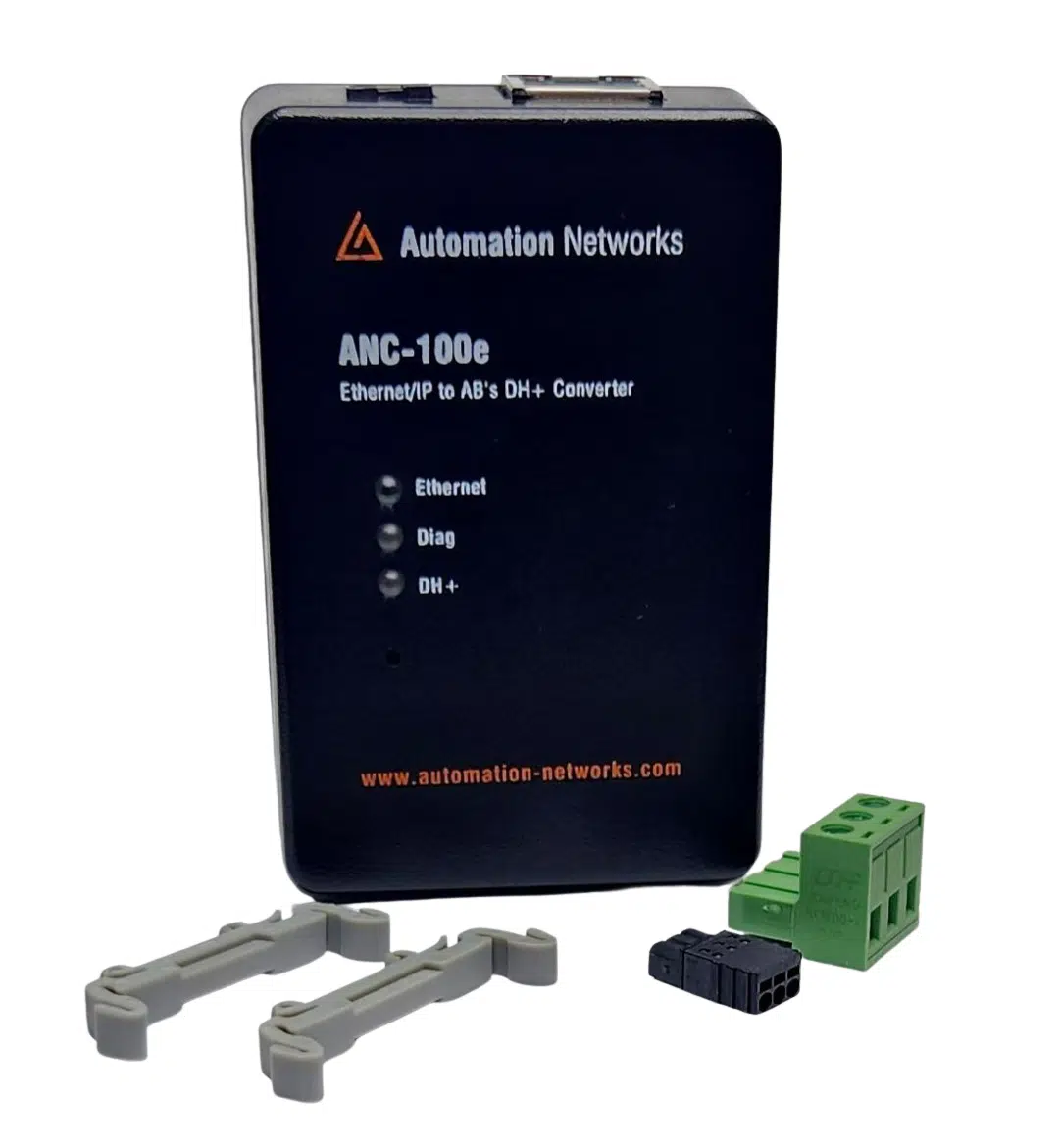
DIN-rail gateway for permanent SCADA, HMI, and PanelView Plus integration to legacy DH+ PLCs.
- • Standalone DH+ gateway architecture
- • Ignition, Kepware & FactoryTalk compatible
- • Lifetime Warranty & 30-day money-back satisfaction guarantee
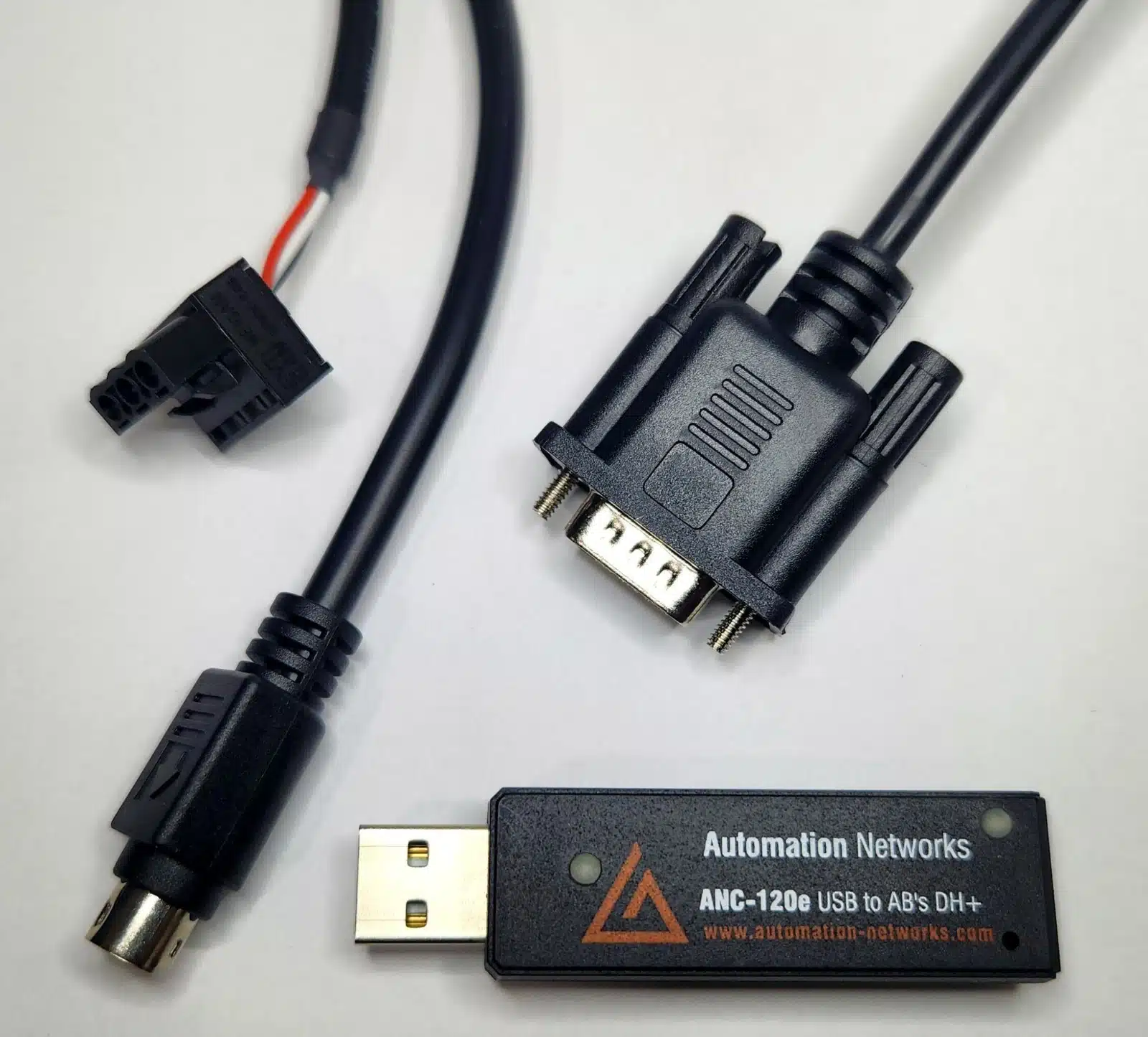
Field-proven 1784-U2DHP alternative. Connect your laptop to PLC-5 and SLC 5/04 controllers via USB on Windows 10 & 11.
- • Windows 10 & 11 (64-bit) native support
- • Cost-effective 1784-U2DHP alternative
- • Auto Baud & Auto Polarity detection